It's that time again, folks. My time as an assistant in l'Arche has ended (though, they say you can take the assistant out of l'Arche, but you can't take l'Arche out of the assistant). Therefore, my blawg title is obsolete, sadly. Time for a change. Naming a blog is no easy-to-acquire skill. These are, presumably, the things I'm trying to avoid:
1) Exclusiveness: Unless I really wanted to post entries about some esoteric interests of mine, I would need to avoid such titles as "Havarti Heaven: A Cheese Blog" or "Stuff Young White Mainline-Evangelical Women Who Are Politically Liberal and Theologically Orthodox Like"
2) Self-Absorbtion: Yes, I'm from the Facebook generation, where I assume everyone cares about my highly-nuanced political and religious beliefs, the number of countries I've visited in the last year, and the books I've read that have 'changed my life.' Blogs are an opportunity for my generation, already completely obsessed with Self, to further bolster the illusion that our ideas are actually new, unique, and deserving of other's attention. Of course, the mere fact that I have access to a personal computer and wireless Internet, as well as having ample leisure time to type away in subtly-hip coffeehouse as I sip delicious, pricey coffee, shows that my ideas are really the ideas of the privileged few. The single mother on government assistance? The migrant farm worker? The immigrant day-laborer? They remain voiceless in the blogosphere where, supposedly, everyone deserves to be heard.
3) Pretentiousness: There is a temptation in the blogworld to elevate the status (i.e. # of hits per day) of your blogged ideas and musings by referencing an obscure (dead) philosopher or theologian as your blog title, "Inside Foucault's Panopticon" or "The Aquinas Tales." Better (or worse) yet is a blog title written in a dead language.
Don't get me wrong. I enjoy reading blogs and have many friends who update regularly. I so enjoy hearing their thoughts and ideas. And I enjoy putting my thoughts and ideas out there, as well. My project here is to create a blog that is not exclusive, doesn't lend itself to self-absorption, and doesn't try to convince others that my thoughts are particularly special. Maybe the project is impossible and I am willing to concede that it is (could my attempt at this be, in fact, a project in self-righteousness??). But if anyone has any fabulous ideas regarding a blog that does not fall into the above three categories, I will delight in them!
Tuesday, June 03, 2008

Friday, May 23, 2008
For those amused/alarmed by Christian sub-culture...
Thanks to the Internets, there are a lot of back alleys where Christians can go to snicker about the ridiculous nature of Christian sub-culture, consumerism, "relevance," and the like. For those that simultaneously delight in and disdain all things Christian, Inc., check these out. If you have any more to offer, please do share:
Lark News - Think of this as an "Evangelical Onion."
Stuff Christians Like - I really like #203 & #208. Similar to SWPL.
How Evangelical Are You? - An important test (your salvation hinges on it) from Lark News.
Oriental Trading Company - No, not a joke, I'm afraid. Those near and dear to me know how much enjoyment I get out of this mass produced Christian kitsch for VBS programs.


Ship of Fools - Go-to site for Christian sub-culture sludge.
Crummy Church Signs - There are a few on here from my area, thanks to my friend Matt.
Church Sign Generator - Make your own crummy church sign! This is mine:
Lark News - Think of this as an "Evangelical Onion."
Stuff Christians Like - I really like #203 & #208. Similar to SWPL.
How Evangelical Are You? - An important test (your salvation hinges on it) from Lark News.
Oriental Trading Company - No, not a joke, I'm afraid. Those near and dear to me know how much enjoyment I get out of this mass produced Christian kitsch for VBS programs.


Ship of Fools - Go-to site for Christian sub-culture sludge.
Crummy Church Signs - There are a few on here from my area, thanks to my friend Matt.
Church Sign Generator - Make your own crummy church sign! This is mine:

Wednesday, May 21, 2008
Things I'm going to miss...

-Eating dinner with a crowd of people each night.
-$1.00 movie nights at the Arlington Cinema Draft House

-Linda's impersonation of me impersonating her ("Geoooorge....).
-The opportunity to share memories and blessings with people during their celebrations.
-"Beer Accompaniment" with Terrence.
-Hazel laughing at my jokes and competing in staring contests in the van.

-Linda rubbing her hands together in delight when she accomplishes a task.
-Long, interesting conversations with Mandy on our many road trips or walks around the block.
-Drinking wine with Dottie in the living room after routine is done.

-Finding the most clandestine way to scoop ice cream in the kitchen.
-Lois - her calming presence, her care, her consistency and commitment to our community.
-Dancing like crazy at our l'Arche holiday parties.
-The spontaneous moments where I find Fritz in the kitchen cleaning, putting away the dishes, and laughing to himself.

-Having ample time to read and rest in my room.
-Happy hour with l'Arche DC folks.
-Helping Linda with her exercises and always being impressed with her perseverance.
-Hearing Alan's movie reviews and sports news.

-Going grocery shopping with Fritz.
-Hazel always seeming to know where exactly I left my keys or my shoes or my purse.
-Having Fritz go through the calendar and tell me about the holidays and happenings of each month, complete with sound effects and hand motions.

-Talking politics with my housemates.
-Fritz's long after-dinner prayer, and the fact that I have it memorized.

Wednesday, May 14, 2008
16 days and counting...
My time in l'Arche is coming to a close. Two communities (Portland & DC), three roles (respite, assistant, and home life coordinator), and 23 months later, I am finishing up my time -- at least for now. Since graduating from college in 2006, this has been my way of life: preparing massive nightly meals, flossing teeth, playing silly games, administering meds, watching Oprah on the couch, filling out droves of paper work, baking cookies, attending multiple weekly meetings, singing songs, shoveling snow off the driveway, dropping people off at work, praying after dinner, sweeping the floor, buying a ton of groceries, leading prayer nights, going on retreats. The day-to-day changes, the various challenges and opportunities, the multiple avenues of growth have proven to be really good fit for my personality. I thrive on change, on each day being different. Monotony tends to deaden my soul.
This life has been a strange mixture of stay-at-home parent, social worker, pastor, and event coordinator. Good, practical life skills earned, for sure, not to mention learning how to posture myself towards the vulnerable and how to identify/come to terms me with my own vulnerabilities. There was a time where this sort of work was frightening and foreign. Though I felt I embodied certain abstract notions of kindness and positivity before coming to l'Arche, I never understood myself as the type of person who could love others in practical, physical ways. Nor could I have ever described myself as a patient person, a listener, a selfless caregiver, a gentle presence. In fact, I think most people who come into l'Arche wouldn't immediately characterize themselves in these ways. And those that do will find that they've never had opportunity to practice patience, forgiveness, generosity. We just don't live in a society where these virtues can naturally be practiced. They have to be conjured up, dusted off, put to good use, else they will atrophy and dissolve.
L'Arche is a place where we can be more fully human. It is a place where we can practice the long-forgotten disciples of simplicity, peace-making, and presence. And it is a place where we can express our hopes, fears, joys, and pains in real, tangible ways. L'Arche provides us, core members and assistants alike, with the opportunity to live righteously in a way that our larger society cannot. We cannot expect the woman in front of us at the post office to treat us with dignity and respect, because this is not the culture of bureaucracy. There, efficiency is paramount, as well as detachment, isolation, and autonomy. We cannot expect the driver behind us on the Beltway to practice selflessness, because this is not the culture of the Beltway. In these places, we have no common culture that informs our behavior or tells us how to love one another. We may have basic common courtesy, but it's a politeness rooted in Kant's Social Contract, not in the theological narrative of the Church.
In a more broader sense, we need the Church to be our common culture, the Body that informs our way of being and doing, of buying and voting. Just as l'Arche has established a way of life for its community members (based on the Beattitudes), the Church must provide a place for us to act out the tenants of our faith. This is why disputes within parishes or dioceses that are settled in a secular court provide no witness for the Church as an alternative culture. This is why parishes that are more comfortable modeling themselves off of the social and fiscal policies of the Republican or Democratic parties have lost their prophetic voice.
L'Arche's uniqueness to the surrounding culture, as well as to any other organization that cares for the developmentally disabled, is so telling. People come to l'Arche and are changed because they've never experienced anything like it before - not in their places of work, their families, or even their churches. Guests who come to dinner talk of their experiences as "brief encounters with Jesus." Core members enter l'Arche after years of living at home or in institutions, and finally, finally they become fully alive. Assistants come to serve and find that they, too, are experiencing healing and growth as they never have before. L'Arche is a different place, an alternative way of being. And it's appeal is wide-spread.
Yes, yes, my time in l'Arche has taught me about myself, about relationships, and community, and loving in tangible ways. But most profoundly, l'Arche has provided me with a vision of what the Church Universal ought to be. It's said that l'Arche is not a solution but a sign to the world, pointing to the Gospel of Jesus Christ. More often than not, the Church believes that She Herself is the solution, when in fact She is called to be the vessel of God's Good News, pointing others towards that which is greater than Herself. If the Church was less concerned about solving problems and more concerned about faithful witness, orthodox theology, and communal identity as a people bound up in the narrative of the Christian faith, perhaps our experience of church would be more transforming, life-changing, challenging, and disciplining, just as l'Arche is. Perhaps the Church would finally start acting like the Church.
This life has been a strange mixture of stay-at-home parent, social worker, pastor, and event coordinator. Good, practical life skills earned, for sure, not to mention learning how to posture myself towards the vulnerable and how to identify/come to terms me with my own vulnerabilities. There was a time where this sort of work was frightening and foreign. Though I felt I embodied certain abstract notions of kindness and positivity before coming to l'Arche, I never understood myself as the type of person who could love others in practical, physical ways. Nor could I have ever described myself as a patient person, a listener, a selfless caregiver, a gentle presence. In fact, I think most people who come into l'Arche wouldn't immediately characterize themselves in these ways. And those that do will find that they've never had opportunity to practice patience, forgiveness, generosity. We just don't live in a society where these virtues can naturally be practiced. They have to be conjured up, dusted off, put to good use, else they will atrophy and dissolve.
L'Arche is a place where we can be more fully human. It is a place where we can practice the long-forgotten disciples of simplicity, peace-making, and presence. And it is a place where we can express our hopes, fears, joys, and pains in real, tangible ways. L'Arche provides us, core members and assistants alike, with the opportunity to live righteously in a way that our larger society cannot. We cannot expect the woman in front of us at the post office to treat us with dignity and respect, because this is not the culture of bureaucracy. There, efficiency is paramount, as well as detachment, isolation, and autonomy. We cannot expect the driver behind us on the Beltway to practice selflessness, because this is not the culture of the Beltway. In these places, we have no common culture that informs our behavior or tells us how to love one another. We may have basic common courtesy, but it's a politeness rooted in Kant's Social Contract, not in the theological narrative of the Church.
In a more broader sense, we need the Church to be our common culture, the Body that informs our way of being and doing, of buying and voting. Just as l'Arche has established a way of life for its community members (based on the Beattitudes), the Church must provide a place for us to act out the tenants of our faith. This is why disputes within parishes or dioceses that are settled in a secular court provide no witness for the Church as an alternative culture. This is why parishes that are more comfortable modeling themselves off of the social and fiscal policies of the Republican or Democratic parties have lost their prophetic voice.
L'Arche's uniqueness to the surrounding culture, as well as to any other organization that cares for the developmentally disabled, is so telling. People come to l'Arche and are changed because they've never experienced anything like it before - not in their places of work, their families, or even their churches. Guests who come to dinner talk of their experiences as "brief encounters with Jesus." Core members enter l'Arche after years of living at home or in institutions, and finally, finally they become fully alive. Assistants come to serve and find that they, too, are experiencing healing and growth as they never have before. L'Arche is a different place, an alternative way of being. And it's appeal is wide-spread.
Yes, yes, my time in l'Arche has taught me about myself, about relationships, and community, and loving in tangible ways. But most profoundly, l'Arche has provided me with a vision of what the Church Universal ought to be. It's said that l'Arche is not a solution but a sign to the world, pointing to the Gospel of Jesus Christ. More often than not, the Church believes that She Herself is the solution, when in fact She is called to be the vessel of God's Good News, pointing others towards that which is greater than Herself. If the Church was less concerned about solving problems and more concerned about faithful witness, orthodox theology, and communal identity as a people bound up in the narrative of the Christian faith, perhaps our experience of church would be more transforming, life-changing, challenging, and disciplining, just as l'Arche is. Perhaps the Church would finally start acting like the Church.
Friday, April 18, 2008
Will Willimon
I'm no United Methodist, but I'm dating one, and I'm about to attend a UM seminary. On top of those things, I've found myself particularly enamored with Will Willimon, former dean of Duke Chapel and bishop of the North Alabama Conference. I didn't know much about Willimon (or Methodism, really) before I started to listen to and read some of his sermons, essays, and interviews. I only knew that he was good friends with Stanley Hauerwas and co-authored the book, Resident Aliens. But, thank you Itunes, I've had the opportunity to hear the wise, gruff, no-nonsense voice of Willimon piped directly into my basement room at l'Arche via his podcasts. As I said, I'm not a United Methodist (and very often Willimon preaches directly to or about the UM church), but I am an ecumenist, and can appreciate the unique gifts and strengths and struggles of other church traditions.
I appreciate Willimon for the same reasons that I appreciate Hauerwas -- neither are willing to bend the knee to the liberal Protestant deism that's profoundly shaping many mainline churches today. Willimon refuses to believe that the Enlightenment is the greatest thing to happen to the Church, nor does he tolerate the idea that theology steeped in individual experience (a liberal AND conservative epidemic) has anything to do with the Gospel. Instead, Willimon believes that the Triune God - Father, Son, and Holy Spirit - is present in our lives, shaping us into disciples, and calling us into relationship. Mainly, Willimon just speaks the truth to conservatives and liberals who've attempted (and often succeeded) at founding their churches on the values of the Republican or Democratic party, rather than the Christian story. Needless to say, what he has to say is extremely refreshing, especially for Christian who can't seem to find a church that speaks out against war and greed AND takes Scripture and church tradition seriously.
As I was searching around for some Willimon gems, I came across a keynote address given at Christ College at Oxford University. It's entitled, "What if Wesley Was Right?" I realize that I know very little about the essence of Wesley's theology, which is why I found this piece particularly interesting, especially in light of the changes and fractures occurring in my own church (the Anglican Communion) and the repercussions those changes have on the Church catholic. It's long, and worth the read; though I can't really do justice summarizing the entire address, here are some parts that made me shout "Amen!"
I appreciate Willimon for the same reasons that I appreciate Hauerwas -- neither are willing to bend the knee to the liberal Protestant deism that's profoundly shaping many mainline churches today. Willimon refuses to believe that the Enlightenment is the greatest thing to happen to the Church, nor does he tolerate the idea that theology steeped in individual experience (a liberal AND conservative epidemic) has anything to do with the Gospel. Instead, Willimon believes that the Triune God - Father, Son, and Holy Spirit - is present in our lives, shaping us into disciples, and calling us into relationship. Mainly, Willimon just speaks the truth to conservatives and liberals who've attempted (and often succeeded) at founding their churches on the values of the Republican or Democratic party, rather than the Christian story. Needless to say, what he has to say is extremely refreshing, especially for Christian who can't seem to find a church that speaks out against war and greed AND takes Scripture and church tradition seriously.
As I was searching around for some Willimon gems, I came across a keynote address given at Christ College at Oxford University. It's entitled, "What if Wesley Was Right?" I realize that I know very little about the essence of Wesley's theology, which is why I found this piece particularly interesting, especially in light of the changes and fractures occurring in my own church (the Anglican Communion) and the repercussions those changes have on the Church catholic. It's long, and worth the read; though I can't really do justice summarizing the entire address, here are some parts that made me shout "Amen!"
- To ask, 'What if Wesley was right?' is to allow ourselves to be challenged by Wesley’s grasp of reality. And if we should be so engaged by him, interrogated by him, and if we find ourselves thinking about God with him, why, we might again become theologians ourselves.
- Rather than assume that the task of the interpreter is to make the text more meaningful to sophisticated, modern people who drive Volvos, Wesley seems to assume that the task of the text is to make the interpreters’ lives more difficult."
- Too troubled by our expectations of what our audience could and could not hear, we reduced the gospel to a set of sappy platitudes anybody could accept and no sensitive, thinking person could resist. “Open minds, Open hearts, Open doors.” Our testimony got reduced to whatever the market could bear.
- Spent Calvinism, sliding into a renovated Deism, has triumphed... God is all distant concept, abstraction, and essence (Marcus Borg’s The Heart of Christianity) and never speaking, revealing, troubling subject. We’ve got just enough God to give our lives a kind of spiritual tint without so much God as to interfere with our running the world as we damn well please.
- Of course, most congregations that I know love such moralistic Deism. The subtext is always, You are gods unto yourselves. Through this insight, this set of principles, this well applied idea you can save yourselves by yourselves. Whether preached by an alleged theological conservative or would be liberal, we’re all Schliermachians now. Theology is reduced to anthropology because unlike Wesley, we’re obsessed with ourselves rather than God. God is humanity spoken in a resonate, upbeat voice backed up with power-point presentation. Our noble Arminianism really does degenerate into Pelagianism when the divine gift of divine-human synergism loses its divine initiation. My image of us United Methodists on Sunday morning is that we come to church with pencil and pad ready to get our assignments for the week, not from God but from the preacher: “This week church, work on your sexism, racism, and be nice to sales clerks. Come back next week and I’ll give you another assignment.” God thus becomes the patron of politics of the right (IRD) or the left (NCC) in a last ditch effort to give God something useful to do.
- Today the Methodist movement, at least in it North American and European vestiges, suffers from the debilitating effects of a truncated theology. We are attempting to revive a church on a too thin description of God.
- When asked, “What qualities do you most desire in pastors who are employed to start new congregations?” Borden replied, “They must be joyfully Trinitarian and orthodox in their theology, stressing the redeeming work of God in Jesus Christ.” I thought I was hearing Wesley.
- On the cross, Jesus didn’t just do something about our guilt; Jesus defeated the kingdom of Satan and established the Kingdom of God; Jesus recreated the world and us, making us into a new people who had a fresh start in life.
- It’s not radical for us to think that we save ourselves by ourselves. What’s radical is to assert a God who is able to work signs and wonders... The Enlightenment still holds our imaginations captive and that captivity is killing us.
Friday, April 04, 2008
Help Save Manassas from "Help Save Manassas"

Those that have been following the despicable, anti-immigrant happenings of Prince William County as of late will appreciate this. The Washington Post just ran a story in today's Metro section about a Prince William County "blog wars" between the hyper-conservative blogger, Greg Letiecq, and left-of-xenophobic blogger, Alanna Almeda. Apparently, Letiecq is one of the more influential residents of PWC, and according to the article, he has "helped elect political allies, punish opponents, and shape local public policy" through his blog (totally frightening, I know - blog culture is so weird). The blog subtitle actually reads, "Driving liberals, dhimmis and illegal alien apologists absolutely insane since 2005..." It receives 1,400 hits a day. I'm feeling a little sick.
Well, Alemda was a contributor to Letiecq's blog for some time until she was removed from the site. Subsequently, she began her own blog (or an "anti-blog," apparently) to counter the xenophobia rampant in Manassas and other parts of PWC. She isn't a liberal, by any means (are there any in this county?), but she thinks the recent immigration policies are totally out of line. Nice that there is an alternative voice out there in the blogosphere, a place where everyone has a voice...or something like that.
Well, Alemda was a contributor to Letiecq's blog for some time until she was removed from the site. Subsequently, she began her own blog (or an "anti-blog," apparently) to counter the xenophobia rampant in Manassas and other parts of PWC. She isn't a liberal, by any means (are there any in this county?), but she thinks the recent immigration policies are totally out of line. Nice that there is an alternative voice out there in the blogosphere, a place where everyone has a voice...or something like that.
Tuesday, March 18, 2008
PostSecret
Similar to Found Magazine, yet a bit more sobering, is PostSecret.

It's been around for a while but I've only just discovered it.
 If you are someone, like me, who is keenly interested in the secrets and idiosyncrasies of other people, check it out.

Be prepared for some serious sadness (though some are lighter - see above).

Perhaps PostSecret will help us to tread more softly around angry strangers or disappointing friends who could very well carry deep wounds.
Found Magazine

People find things...notes, pictures, ticket stubs....

and if they are interesting, they put them online.

These are some great ones I saw today.

Friday, March 07, 2008
The Virginia state government approved a bill to "eliminate gaps in the mental health system" as brought to light by the recent Virginia Tech shooting. Needless to say, this bill has me excited. We encountered absurdity after frustrating absurdity when we tried to committ ED to psychiatric care last summer. Even when we saw him spiraling down mentally and emotionally, we could do nothing but wait for his behavior to become so out of control that we had to call the police. No joke.
ED is his own guardian, and even though he had not committed a crime, his mental illness compounded with his mental retardation (dual diagnosis) pretty much added up to involuntary admission. There's no way someone like ED is going to voluntarily sign up to spend the night in a foreign place away from familiar people. This is just unrealistic. ED's self-gaurdianship is an important part of his individuation and independence as an adult with MR. I would never want this taken from him because of his mental illness. Instead, this law would make it possible for mental health professionals to admit adults w/o guardians to mental health facilities for treatment.
If this law had been in place BEFORE the Spring/Summer of 2007, we would have been able to get ED treatment long before he spiraled out of control. We would never have had to endure the trauma of calling the police who would then handcuff ED, put him in the patrol car, drive over to the nearest ER, and sign a bunch of papers to admit ED into the hospitals care. We wouldn't have had to go to court the next day, ED still in handcuffs, and make the case to the judge that ED is mentally ill and needs to be placed in a psychiatric facility. It was a horrendous process and one we had to go through twice. Rediculous.
I'm relieved that this process can now be bypassed, that the police and the court room and the judge can be cut out of the equation, that people like ED won't be criminalized/demonized because of their mental illness or mental retardation.
ED is his own guardian, and even though he had not committed a crime, his mental illness compounded with his mental retardation (dual diagnosis) pretty much added up to involuntary admission. There's no way someone like ED is going to voluntarily sign up to spend the night in a foreign place away from familiar people. This is just unrealistic. ED's self-gaurdianship is an important part of his individuation and independence as an adult with MR. I would never want this taken from him because of his mental illness. Instead, this law would make it possible for mental health professionals to admit adults w/o guardians to mental health facilities for treatment.
If this law had been in place BEFORE the Spring/Summer of 2007, we would have been able to get ED treatment long before he spiraled out of control. We would never have had to endure the trauma of calling the police who would then handcuff ED, put him in the patrol car, drive over to the nearest ER, and sign a bunch of papers to admit ED into the hospitals care. We wouldn't have had to go to court the next day, ED still in handcuffs, and make the case to the judge that ED is mentally ill and needs to be placed in a psychiatric facility. It was a horrendous process and one we had to go through twice. Rediculous.
I'm relieved that this process can now be bypassed, that the police and the court room and the judge can be cut out of the equation, that people like ED won't be criminalized/demonized because of their mental illness or mental retardation.
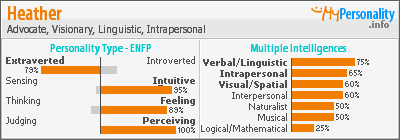
Another test....geez!
Really, no surprises here, as always. I am no longer a mystery to myself. Sadly.

Sunday, February 24, 2008
Theological "worldview"
According to this test, I am a neo-orthodox (though there is no post-liberal designation as far as I can tell) ...and only 7% Fundamentalist! I feel pretty good about the top three -- 1) Neo orthodox, 2) Roman Catholic, and 3) Emergent/Postmodern. Feel free to take the quiz and report your results. I'm really hoping someone gets Classical Liberal. Or Fundamentalist. I'll keep my fingers crossed.


You scored as a Neo orthodox
You are neo-orthodox. You reject the human-centredness and scepticism of liberal theology, but neither do you go to the other extreme and make the Bible the central issue for faith. You believe that Christ is God's most important revelation to humanity, and the Trinity is hugely important in your theology. The Bible is also important because it points us to the revelation of Christ. You are influenced by Karl Barth and P T Forsyth.
Neo orthodox 82%
Roman Catholic 68%
Emergent/Postmodern 61%
Evangelical Holiness/Wesleyan 54%
Classical Liberal 29%
Modern Liberal 29%
Reformed Evangelical 25%
Charismatic/Pentecostal 18%
Fundamentalist 7%
Friday, February 01, 2008
Things that are easier, things that are hard...
I can't figure it out. I have been living in l'Arche for a total of 20 months (and in the Greater DC community for 17), and life has truly never been easier. I'm trying to discover the root of my feelings of contentment, but its a difficult task. I have long since passed the idealistic, everything-about-l'Arche-is-wonderful stage....that probably ended the second month I was here. And I've also passed the stage of "finally feeling settled" at least a year back. And this isn't much of a milestone because I adjust pretty easily to new situations. But truly I say to you, l'Arche is easier now than it's ever been. There could be multiple reasons for this, both internal and external.
First, life in this home was tumultuous, to say the least, when I first arrived. There were some major turn-over in assistants and leadership and some huge governmental hurtles to overcome before this house even opened. Plus, all of us were new -- core members and assistants. There were no routines, no traditions, no foundation upon which we could base our life together. We had to figure out how to do everything anew while also abiding by the simultaneously strict and ambiguous regulations of the county and state government (we were the first group home to open in Northern VA in more than a decade).
Also, because we were stressed, relationships in the house were stressed. You couldn't gather together people so different from one another even if you tried. And we were living under the same roof, buying groceries together, working together, essentially spending our entire lives together. And yet, there was some serious interpersonal tension hanging over our heads for a while there. As we were attempting to facilitate positive, healthy relationships among the core members, we were having our own issues that were either ignored or denied. Though I wasn't a member of one of the "opposing" parties, I was affected greatly by the simmering conflict.
Along with this, one of our core members began to mentally and emotionally disintegrate. These downward spiral started off subtly but generally grew, ranging from depression to full-blown outbursts to a week or two of hypomanic elation. Yikes. No week was like the next. And we had few, if any, supports in regards to good psychiatric care and counseling. We had to juggle this core members volatile moods with the basic needs and cares of the house and other core members, and this was no easy task. Our team meetings would stretch so long sometimes, up to 3 hours, because we had so much to talk about. And we were exhausted.
Then, come May 1st of 2007, I became the Home Life Coordinator, essentially taking on responsibility for the tensions and anxieties already present in the house. Along with adjusting to my new role as head of house, this core member took a turn for the worst and went into the pysch hospital twice. An assistant left rather unexpectedly and we struggled to find a replacement in the midst of the crisis we were experiencing in the house. And I was biting off more than I could reasonably chew -- performing all the duties of leadership while still working 40 hours a week of routines and accompanying a core member. I became so stressed that I started losing weight and developed acid reflux. I had difficulty sleeping and essentially avoided being in the house when I wasn't on call.
After toiling through several months of chaotic life in the home (primarily centered around this one core member), we made the tough decision of discharging this core member from the home. We couldn't meet his needs. We couldn't support him in his mental illness. We were in way over our head. And yet we loved him and cared for him and dreaded seeing him go. But, as we suspected, life afterwards was just...easier. Relationships in the house were gelling, other core members were happy, new assistants were being oriented and taking on more responsibility, I was building strong friendships with other members in leadership. And, on top of all this, I was learning to let go of some of the unrealistic expectations I had for myself as Home Life Coordinator. I learned to follow through with the important tasks, to not take myself too seriously, to say no to things I knew I couldn't do, to lead by example, to have fun and laugh when mistakes happen. In a sense, my newly found comfort with my newly acquired role may be the internal factor that has made life easier now.
When I look back at the first 8 months of our life as a l'Arche home, I am amazed we came out on the other side! This is not to say, of course, that we never experienced times of joy and grace within our community. There were plenty of those...countless good memories, funny stories, interesting experiences. But life was, in fact, hard. And I think I realize that now that I'm on the other side, breathing a sigh of relief, sleeping in late, spending my weekends at l'Arche rather than fleeing to my parents' house. Humans are highly adaptable, and we adapted....we made do. But we weren't necessarily thriving.
I have much to say to other l'Arche communities who, more often than not, "make do." They hire assistants who are clearly inept or carry weight baggage into the community. They bring in core members who cannot be fully supported in a l'Arche setting, core members who ultimately toxify community life. They become so stuck in tradition and ritual that they are no longer open to new ideas, new ways of doing things. They keep the same individuals in leadership positions for years on end, individuals who may not be doing their job to the best of their ability. Blah blah. There are ways to be a healthy community, and there are ways to pollute a healthy community.
Life is easier now, and I like to think that it's not just the external environment that has prompted this change, but my own internal environment. I like to think that I could face any number of hardships, knowing that I have faced tremendous hardship in the past. I like to think that the challenges of l'Arche have changed me, made me a better human being - more patient, less fearful, more realistic, less anxious.
All this being said, my official "end time" is the end of May -- that leaves me with 3 more months. Hard to believe! Feels like I just got here, and now I'm the "old and experienced one" admits the new assistants. I am feeling good about tying up my time here in l'Arche, but I obviously have some ambivalent feelings about leaving. I've been "living l'Arche" since I graduated from college, so it's pretty remarkable to think about doing something else. But isn't that what my life has been for the last few years? Transition here, transition there. Packing up, moving along, meeting new people, saying good bye.
First, life in this home was tumultuous, to say the least, when I first arrived. There were some major turn-over in assistants and leadership and some huge governmental hurtles to overcome before this house even opened. Plus, all of us were new -- core members and assistants. There were no routines, no traditions, no foundation upon which we could base our life together. We had to figure out how to do everything anew while also abiding by the simultaneously strict and ambiguous regulations of the county and state government (we were the first group home to open in Northern VA in more than a decade).
Also, because we were stressed, relationships in the house were stressed. You couldn't gather together people so different from one another even if you tried. And we were living under the same roof, buying groceries together, working together, essentially spending our entire lives together. And yet, there was some serious interpersonal tension hanging over our heads for a while there. As we were attempting to facilitate positive, healthy relationships among the core members, we were having our own issues that were either ignored or denied. Though I wasn't a member of one of the "opposing" parties, I was affected greatly by the simmering conflict.
Along with this, one of our core members began to mentally and emotionally disintegrate. These downward spiral started off subtly but generally grew, ranging from depression to full-blown outbursts to a week or two of hypomanic elation. Yikes. No week was like the next. And we had few, if any, supports in regards to good psychiatric care and counseling. We had to juggle this core members volatile moods with the basic needs and cares of the house and other core members, and this was no easy task. Our team meetings would stretch so long sometimes, up to 3 hours, because we had so much to talk about. And we were exhausted.
Then, come May 1st of 2007, I became the Home Life Coordinator, essentially taking on responsibility for the tensions and anxieties already present in the house. Along with adjusting to my new role as head of house, this core member took a turn for the worst and went into the pysch hospital twice. An assistant left rather unexpectedly and we struggled to find a replacement in the midst of the crisis we were experiencing in the house. And I was biting off more than I could reasonably chew -- performing all the duties of leadership while still working 40 hours a week of routines and accompanying a core member. I became so stressed that I started losing weight and developed acid reflux. I had difficulty sleeping and essentially avoided being in the house when I wasn't on call.
After toiling through several months of chaotic life in the home (primarily centered around this one core member), we made the tough decision of discharging this core member from the home. We couldn't meet his needs. We couldn't support him in his mental illness. We were in way over our head. And yet we loved him and cared for him and dreaded seeing him go. But, as we suspected, life afterwards was just...easier. Relationships in the house were gelling, other core members were happy, new assistants were being oriented and taking on more responsibility, I was building strong friendships with other members in leadership. And, on top of all this, I was learning to let go of some of the unrealistic expectations I had for myself as Home Life Coordinator. I learned to follow through with the important tasks, to not take myself too seriously, to say no to things I knew I couldn't do, to lead by example, to have fun and laugh when mistakes happen. In a sense, my newly found comfort with my newly acquired role may be the internal factor that has made life easier now.
When I look back at the first 8 months of our life as a l'Arche home, I am amazed we came out on the other side! This is not to say, of course, that we never experienced times of joy and grace within our community. There were plenty of those...countless good memories, funny stories, interesting experiences. But life was, in fact, hard. And I think I realize that now that I'm on the other side, breathing a sigh of relief, sleeping in late, spending my weekends at l'Arche rather than fleeing to my parents' house. Humans are highly adaptable, and we adapted....we made do. But we weren't necessarily thriving.
I have much to say to other l'Arche communities who, more often than not, "make do." They hire assistants who are clearly inept or carry weight baggage into the community. They bring in core members who cannot be fully supported in a l'Arche setting, core members who ultimately toxify community life. They become so stuck in tradition and ritual that they are no longer open to new ideas, new ways of doing things. They keep the same individuals in leadership positions for years on end, individuals who may not be doing their job to the best of their ability. Blah blah. There are ways to be a healthy community, and there are ways to pollute a healthy community.
Life is easier now, and I like to think that it's not just the external environment that has prompted this change, but my own internal environment. I like to think that I could face any number of hardships, knowing that I have faced tremendous hardship in the past. I like to think that the challenges of l'Arche have changed me, made me a better human being - more patient, less fearful, more realistic, less anxious.
All this being said, my official "end time" is the end of May -- that leaves me with 3 more months. Hard to believe! Feels like I just got here, and now I'm the "old and experienced one" admits the new assistants. I am feeling good about tying up my time here in l'Arche, but I obviously have some ambivalent feelings about leaving. I've been "living l'Arche" since I graduated from college, so it's pretty remarkable to think about doing something else. But isn't that what my life has been for the last few years? Transition here, transition there. Packing up, moving along, meeting new people, saying good bye.
Friday, January 11, 2008
April 2006
A Trip to Transylvania and a Car Accident
Brasov (known as the “Prague of Romania”) and Sibiu were also great places to visit. We went to several museums and churches and got into some nice, healthy debate with Cornel about the importance and relevance of the Old Testament to the Christian faith (I could feel the spirit of one Marv Wilson stirring inside me as I emphasized the importance of 80% of the historical Scriptures). This is not to say, of course, that the Orthodox don’t place importance on the Old Testament…they (at least Cornel) just think that the New Testament is the most important. I, of course, begged to differ. But I wouldn’t be surprised if good portions of both of our arguments got lost in translation, which happens often here.
On our way back from Brasov to Sighisoara, we were riding through the middle of town and had to swerve out of the way of some insanely slow pedestrian walking across the street. As we did, our car fishtailed a bit and we side-swiped an on-coming car. Fortunately we weren’t going too fast and the other car was barely damaged, but the Dacia wasn’t looking too great when we inspected it further. Nothing happened internally, but the entire side bumper on the driver’s side had been bent outwards and one of the headlights was broken. After 3 hours of lovely Romanian police bureaucracy, we took the car to a mechanic and got a taxi ride back to Dorothy’s place. No real harm done and the mechanic cost hardly anything at all.
My Final Letter from Romania
Dragut si dragas,
As I write this, I have only two nights left in Romania, only one of those left in Lupeni. It literally seems like ages since Bethany and I first got here. We can hardly believe that there was a time when we hadn't heard the Romanian language, when we hadn't met Dana and Brandi, when we hadn't seen the beautiful mountains of Romanian. It's experiences like these that can feel so short yet so rich and fulfilling. Three months usually go by in a flash, but when each day of those three months is filled with newness, each week passes like a year. But now looking back, I realize that this time is a drop in the sea compared to my 22 years on earth. How amazing that we can learn more and experience more in those tiny moments than we can in a decade! Einstein was right when he stated that time is relative.
As I write this, I have only two nights left in Romania, only one of those left in Lupeni. It literally seems like ages since Bethany and I first got here. We can hardly believe that there was a time when we hadn't heard the Romanian language, when we hadn't met Dana and Brandi, when we hadn't seen the beautiful mountains of Romanian. It's experiences like these that can feel so short yet so rich and fulfilling. Three months usually go by in a flash, but when each day of those three months is filled with newness, each week passes like a year. But now looking back, I realize that this time is a drop in the sea compared to my 22 years on earth. How amazing that we can learn more and experience more in those tiny moments than we can in a decade! Einstein was right when he stated that time is relative.
I spent time yesterday staring out the window of the maxi-taxi as we cruised from Lupeni to Cheile Butti (30 minutes away) and my friend Diana asked, "What are you doing?." I said "Trying to commit Romania to memory." I'm trying to memorize this place, the shape of the mountains, the smell of the air, the taste of zacusca, the rolling r's of the Romanian language, the forlorn whistle of the coal train that lumbers through town each night, the peasant women in head scarves shuffling slowly across the street, the cold air against my face when I sleep at night, the clip-clop of horse-hooves, the laughter of my friends.
I was reading my Myers-Briggs profile the other day, and apparently, ENFPs see the world in very symbolic terms. And I can vouch that my typology is accurate, because I tend to view all moments as "pregnant with meaning" in the words of Henri Nouwen. I'm not sure how exactly I ended up in Romania, how I met the people I did and experienced the things I experienced. That is up to God to know and to orchestrate. But I can say that there is purpose and meaning behind all these things, though I can't necessarily specify them. Maybe it's just enough to know that these things are meaningful, these friendships, these conversations, these challenges, these steps on once-foreign sidewalks -- that these things have purpose and meaning and fit into some greater, unimaginable whole. Maybe we don't need to toil over what these meanings are but just let the experiences speak for themselves. If we let them, they do speak quite loudly.
I am excited about going home, though overwhelmed by the many more transitions and responsibilities that await me. Graduation. Summer plans. Future jobs. Where to live. What to do. Saying good bye to friends. Lots of open-endedness, lots of loose ends. But, like countless times before, I can only assume that things will sort themselves out and that no amount of my bood, sweat, and tears are going to radically alter the course of my life. I just need to be faithful with the small decisions and be faithful to what I know, however limited. And then, all will be fine.
I return to the States on Good Friday in the afternoon. I hope to be back up at Gordon on Tuesday, maybe Wednesday. Then I'll be there until graduation. This summer is still a mystery, though I'm hoping to spend some time in Portland, Oregon, with my sister and her boyfriend. Then, after that...Virginia? Massachusetts? Oregon? Romania? Time will tell.
I want to thank all of you for your support and encouragement and friendship that I have felt this many miles away during my time here in Romania. These experiences would mean nothing to me if I didn't have people to share them with, so I am glad to know that you all are there receiving these written processings.
You all are great! Much peace...pace mult.
Heather
March 2006
Beginning Orthodox Lent
On Sunday, we had a feast-before-the-fast (a Shrove Sunday, if you will) at Diana and Cornel's place. I baked and baked most of Saturday and brought over some banana bread, a pan of brownies with frosting, and a spinach quiche. I've been cooking and baking like a maniac since I've been here and have really enjoyed it. Perhaps the most amazing part is that we don't have any measuring cups or spoons, and our gas oven's settings are simply "big flame", "little flame." So, when a recipe calls for two cups flour, I take a wild guess. And when it calls for 300 degrees, I opt for the "little flame." Most things turn out quite swimmingly. I've always been under the impression that recipes are mere guidelines, much to my mother's chagrin. After we stuffed ourselves exorbitantly, we played Uno which, with Romanians, is much more exciting and rowdy than with Americans. And I won't even go into the insanity that followed when we played Dutch Blitz. We thoroughly exhausted ourselves playing cards, so we watch The Pianist, which was quite sobering, and drank boiled wine.
Living without Running Water
Bethany and I finally connected with a plumber who came and fixed our bathroom leak yesterday. Of course, when I went to turn on the shower this morning, the water in our building was off (happens once or twice a week) and I could only laugh at the irony of it all. You don't realize how dependent you are on running water until you have none -- you can't brush your teeth, wash your clothes, make a cup of tea, take a shower, wash your face, etc. What a valuable resource! And yet so many in the Two-Thirds world live tens of kilometers from clean water sources. It's really something you don't think about in the States. Every time I travel and return home, I always have to adjust to drinking water straight from the tap. We have the cleanest drinking water in the world! During your next shower or when you drink your next glass of water, say a little prayer of thanks...and consider turning the water off while you brush your teeth.
Springbreak in Budapest
B and I returned from our Spring break adventures last Sunday morning at 5am. Unlike the way to Budapest, our train ride on the way back was nice and cool (we could actually open our window) and there were no old, drunken men trying to get into our cabin, which was a nice change. I really enjoyed Budapest, especially because I was able to experience it with my two good friends. We enjoyed many a cappuccino, walked a LOT, saw some sweet museums, learned a little more about the Balkan wars and communism, relied heavy on the recommendations of travel writer Rick Steves (we swear by him), learned a smidgen of Hungarian, soaked in some thermal baths with the locals, saw a French opera in Hungarian subtitles for very cheap, enjoyed good Hungarian beer, got overcharged for some chicken paprikash, successfully avoided bird flu-ridden pigeons, had some killer Indian food, and made quite the home of our two hostels where we stayed. All in all, good times.
I really am thankful for having more than one perspective of Eastern Europe. Clearly, communism in Hungary looked different than the communism of Romania. Both were destructive, of course, but you only have to ride on a Budapest metro or walk the Budapest streets to feel the obvious difference. Romania is soooooo far behind other former Soviet bloc nations that it’s not even funny. Maybe that’s because after their revolution, they voted in another communist politician! And again and again…. It’s hard to transition out of oppression when the oppression rules the state. Fortunately, and this is very new, the powers that be are being held responsible for the massive amounts of money they’ve “magically” acquired over the years, specifically Nastasu, the former prime minister, who recently resigned. We think he may be a billionaire.
Overcoming My Fear of Skiing
Well, when you think ‘mountain retreat,’ you think of adjectives like ‘quite,’ ‘restful,’ ‘slow-paced.’ Welp, not so for Straja. I’ll say this over and over again – that place is crazy. You get to the top and there are mounds of people, all wearing neon-colored full-body snow suits straight from the 80s, skiing and snowboarding in all directions, with stray dogs running this way and that. And the cabana where we stayed was equally as crazy, filled with ski bums and loud partiers. Our room was actually directly next to the disco….and I mean that quite literally. The walls were literally shaking until 2 in the morning. AND, the water was off for two days, so that meant no showers and much odor….to put it nicely.
Anyway, I finally tried my hand at skiing and actually did okay! It must be like riding a bike…once you learn, it’s hard to forget. I went down the easy slope a few times until the electricity went off (haha! Romania! No water or electricity at a ski resort) and the lift stopped working. So, I just put my skiis on my shoulders and trudged up the mountain side, bit by bit. This was hard after a while and by mid-afternoon, I called it a day. But, I am proud to say that I never fell…not once. We went sledding later on and I fell a lot, and acquired some pretty nasty (identical) bruises on the back of my calves. Honestly, sledding has to be far more dangerous than skiing. The only way you can stop is completely uncivilized – throwing yourself off the sled and hoping that you’ll land into a pile of snow and eventually stop before rolling off the edge of some great Romanian precipice. It’s an adrenaline rush, for sure.
Evangelicals and Orthodox in Romania
One of my (and Dana’s) many criticisms of Evangelical missions organizations that come to Romania is their refusal to work with the Orthodox Church. In fact, many of these mission organizations have outright hostility toward the Church, and have made it their goal to convert the “pagan Orthodox” to their understanding of Christianity. This disturbs me. And this is why I am blessed and encouraged to be a part of New Horizons, an NGO that partners with the Orthodox Church to do the good work God has for us – creating loving communities, instilling values of faith and trust and compassion in individuals, and spreading the gospel of shalom. Grant it, there are those priests (and aspects of the OC) that are rigid and intolerable. But the priests I’ve met and the theology I’ve read have really blown my previous perceptions out of the water. I think the American Evangelical Church has much to learn from the OC in terms of the sociability of the Trinity, the organic connection between the Gospel and social justice, and ecumenicalism. It’s time to stop being fearful of icons, everyone!
February 2006
Western Development vs the Orthodox Church
I am really glad that we read Erich Fromm's Escape from Freedom before I came here. So many Western development agencies assume that democracy and 'freedom' are basic human desires. But, according to Fromm and real world examples (Iraq, Romania), humans flea from responsibility, from the chaos of 'people ruled' government. That's what I really appreciate about this organization -- NH doesn't assume that values needed for democracy are intrinsic in the Romanian people. Communism pretty much destroyed Romania's moral education and social capital is non-existent. So, through service learning projects and basic moral and ethical teachings (love your neighbor as yourself, respect one another, work together, don't steal, cheat, lie), NH is attempting to get kids off their ass and do something about their situation! And that's hard, exciting work.
Of course, all of this is making me think a lot about the way Romanians view the Self (before, during, and after Communism). It seems that the only thing that really gives anyone any sense of purpose here is cheating their way out of responsibility, doing as little work as possible, and drinking a lot. It's almost a cultural pathology...which I guess is controversial to say. But yet, the Orthodox Church has remained one of the only social institutions that Romanians trust. They are a highly religious people....so it would seem that the Church could be harnessed to provide a moral education for its parishioners. However, the Church hasn't played a prophetic role in society for a long, long time. I find the Orthodox Church fascinating nonetheless and really think that their theology (human containing potential for good rather than human as depraved animal) can be used to bring about change!
Visiting an Orphanage
Many of you probably associate the word 'orphan' or 'street child' with Romania because of the media coverage of the early 90s. State-run orphanages at that point were hell holes, institutions holding far too many kids with too few resources. Many of the children were confined to dark, dirty basements for most of the year with no sunlight and meager food. Most had major vitamin deficiencies. Plenty of reform has happened since then and many state-run institutions have turned private. The one we visited is run by a Baptist church and held 20 children under the supervision of 4 or so adults. The place was clean and safe and the children seemed happy and well-fed. You could tell, of course, that these children had had their share of difficulties in their lives. Many of them were underweight for their ages. Two of the smallest children (I guessed 4 and 5) were actually 8 and 9. I was shocked. Many of them were Roma (Gypsy) children who automatically face greater challenges in their lives just for being Roma. We played games with the kids for a while and brought them oranges and held their hands. Those who've been so deprived of touch, of basic human affection, want nothing more than to interact physically with those willing. These kids were itching to touch and be touched, even by a stranger. How vulnerable they are to exploitation! How open they are to human love and compassion!
Communicating Cross-culturally
Tomorrow I am helping lead a required seminar for all staff called "Leveraging Traditions," attempting to integrate Orthodox theology with development work. My presentation is on the Capabilities Approach (Martha Nussbaum) and I've already had trouble with translation (there is no word for 'capability' in Romania...so we used 'capacity'). Much time here is spent tossing a single idea back and forth until both parties (Romanian and American) understand -- that's why it takes longer to accomplish anything here. And, inevitably, stuff gets lost in the translation. But, I've actually really enjoyed some of the conversations I've with folks like Cornel -- he really helps me to take my ideas out of the clouds and make them accessible to those who literally don't speak my language. And, in the end, you realize that all the high-and-mighty vocabulary, all the literary allusions, all the witty alliteration may only serve to barricade a potentially weak, ill-formed idea. A strong idea really is one that can speak for itself.
Hyper-individualism vs Hyper-collectivism
The importance of being true to one's self is all the more evident now that I'm in Romania. After 40 years of deception, corruption, and denigration of the individual (the self), people have lost sight of who they are and who they could be! You said quite poignantly, "it is criminal what happens to human beings when hope is rendered meaningless." How about when the self is rendered meaningless? How can you be true to what you've been told does not exist? Or, what at least has no value? Perhaps quite similarly, American Christians, having been raised in a nation where the individual is worshipped, don't know how to be faithful to their true selves because they've been so blinded by the facade of individuality that America (the West) feeds them. How can you be true to yourself when you are alienated from context, history, society, others? How can you be true to an over-exalted self? An island among islands?
Save the Children - HIV Positive Youth
Bethany, and I visited Save the Children in Petrile yesterday and had a good visit. They've had an HIV-AIDS integration group running for about two years, thanks to a grant from the States, which works with infected youth to help them integrate into the local communities. There is a lot of stigma here against HIV-positive kids, as there is anywhere. Perhaps the most tragic thing is that these kids were infected passively, not by drug use or sexual activity, but by corrupt medical practices -- doctors and nurses who performed blood transfusions with dirty blood and dirty needles.
I've written about this before, but it still plagues me. I asked the woman who ran the group if there had been any reparations from the hospitals for their malpractice and, in a very Romanian way, she responded with "No, not really." It's a very 'hasta este' attitude -- it is what it is. She said that this program was established to respond to the problem, not necessarily to seek justice. Of course, you can imagine the look on my face when I heard that. In the US, those hospitals would have suffered from serious malpractice suites, those doctors and nurses would be out of jobs, and those kids would be receiving medical attention (potentially). But here, life goes on. People fuck over other people and that's how the story goes. Where's the justice here? the restitution? These kids were given death sentences before they could even walk, ...and most won't live past 18 (their cases are very advanced), all because of corrupt medical practices. [Very often, people have to pay medical professionals bribes to receive good care, otherwise they come out worse than they came in and are then more desperate to receive care than before. Sick, I know.] Anyway, this is just a drop in the sea of injustices that have occurred in this country over its long, sad history. Imagine injustice after injustice going unpunished year after year and what that will do to your psyche. Fatalism is the best defense, presumably.
January 2006
Getting the Lay of the Land
To give you the lay of the land, I'll describe the town of Lupeni where we reside. Imagine tall smoke stacks (occasionally spewing black smoke from the coal mines) and communist block apartments, 10 or so stories high. Lupeni itself is only one or two square miles....but there are 30,000 citizens here, all stacked on top of one another. There are lots of wild dogs roaming the streets and when I was looking out our window today at the 'park' below, I saw a big, black hog chilling in the grass. Hilarity. The mountains that surround us help to redeem the ugliness of Lupeni. They are snow-capped and gigantic, and at night you can see the lights of the ski resort on one of the peaks. There are good things about Lupeni -- the 'bread box' outside our apartment door (a one-room shack of sorts that sells some AMAZING bread), the Pizza Planet, the open air market which sells vegetables, and the chairlift that goes up the mountain to the ski resort...and our sweet apartment.
An Introduction to Corruption
We had a good introduction to corruption last night when we attempted to attend an IMPACT meeting at one of New Horizon's buildings (recently remodeled....it was a big investment on their part). Bethany and I and the kids show up and notice smoke billowing from the roof, and we can see the yellow and orange tinge of fire. One of the kids turned to us and very matter of factly said, "It looks as if the roof is on fire." Bethany and I being American are thinking ...."What can we do? How can we help?"....but in a place where fatalism rules and power is in the hands of the few and corrupt, these things happen and the best way to cope is apathy. Fortunately, some of the leaders and staff members showed up and called the fire department, but the trucks didn't come for almost 30 minutes (they originally thought our call was a joke). When the first truck came, the firemen rolled out slowly, half-dressed in their uniforms, and looked at their hoses like they had never seen them before. One of the kids said to us, "It's just like on TV but in slow motion." and we all got a big laugh. Dana turns to the crowd after the fire had died down (it was localized, fortunately) and said, "This is why we are fighting corruption. This is what happens." Apparently, when the coal fire was lit to heat the building, someone had overcompensated for the previous night when the building was freezing, and the intensity of the heat had melted the tubing around the stove. We found out later that the tubing was actually made of plastic. No one in their right mind would put plastic in the heating system unless they were pulling a scam. And there's one for ya! This is Romania....this is the type of corruption New Horizons is attempting to address.
Ceausescu
These days, we have a hard time distinguishing between what is real and what isn't....real or fake tree, real or fake hair color, real or fake breasts, real or fake apple. In many ways, it's the faux that's become the ideal: the wax fruit free of any mark or the freckle-less, cellulite-less, hairless models in magazines. What is real has become secondary to what is not real. And we wonder why we are depressed, angry, shooting our classmates in high school (video games: line between real and imaginary?). Communism was all about facades. Everything had the appearance of wealth and modernism, but most things were actually decaying inside, like a gutted building with painted shutters. In fact, whenever Ceausescu came into town, people would paint the leaves on the trees green. It was a facade. And Ceausescu exported all Romanian fruits and vegetables to other countries to make it apear like Romania was doing great financially, when in actuality, 90% of its citizens were starving. It was a facade of development and still is in many ways. That's why the post-communist world fools you. Africa doesn't fool you....development there is a new thing (gas stations, sky scrapers, all new). But here, some semblence of infrastructure has remained, but things run inefficiently, shops close at random hours, people are freezing inside their apartments because gas is being rerouted to the mayor's home, roads are left riddled with potholes winter after icy winter and left in disrepair for years.
Romania, la mults ani!
One of these days, I'm going to relinquish my Gordon email address for something more up-to-date. This will be a symbolic move for me, of course, as everything in my life tends to hold some sort of meaning or significance, no matter how seemingly mundane. But in the mean time, I continue to battle Exchange on a monthly basis as I receive emails about having too many messages in my box -- and then I spend an hour or so painstakingly perusing my old emails, saved and sent, deciding which are worthy of taking up precious megabites and which can be deleted for eternity.
Sounds strange, but this is a difficult task for me. Many of my emails of yore are written more like essays than simple correspondence. In them, I have pieced together my thoughts and feelings regarding my current state of being into a coherent whole. Not only that, these emails, filled with my philosophical-sociological-theological discoveries about the world, represent an exchange of ideas between people I care about. These interchanges are meaningful precisely because they involve other minds, other experiences. Like journal entries, my old emails are written snapshots of my past thought-life and my past relationships. Parting with them feels like parting with memories.
All that being said, I received one such threatening message about my mailbox size exceeding the maximum limit, and as I was reading through my 700-something sent messages, I found several mass emails I sent to friends while I was in Romania. I really have enjoyed reading these again, because they served to illuminate just how much I was changed by my experience in Romania, even if I was there only a mere quarter of a year. My time in Romania was so rich and I encountered such astounding people doing astounding things in such a painful, beautiful place. I would argue that my first steps towards considering seminary education started because of my friendship with Dana Bates. He really taught me what it meant to be a thoughtful, passionate Christian and how a good, solid, informed theology can really translate into practicing the Gospel. Dana made me realize that the world of ideas and the world of action can and should intersect.
In fact, just two years ago on (or around) this day, Bethany Jones-turned-Arnold and I were boarding a plane at the Philadelphia Airport, bound for Romania via Frankfurt. When we arrived, there were banners on most buildings that read, "La Mults Ani," or "Happy New Year" in Romania. We lived out the first few days of 2006 in Lupeni, Romania, of all places. Remarkable to think about.
For posterity's sake, I've decided to publish a few of the emails I sent while I was in Romania because I think they are worthwhile to read and remember. The next few posts will be excerpts from such emails.
Sounds strange, but this is a difficult task for me. Many of my emails of yore are written more like essays than simple correspondence. In them, I have pieced together my thoughts and feelings regarding my current state of being into a coherent whole. Not only that, these emails, filled with my philosophical-sociological-theological discoveries about the world, represent an exchange of ideas between people I care about. These interchanges are meaningful precisely because they involve other minds, other experiences. Like journal entries, my old emails are written snapshots of my past thought-life and my past relationships. Parting with them feels like parting with memories.
All that being said, I received one such threatening message about my mailbox size exceeding the maximum limit, and as I was reading through my 700-something sent messages, I found several mass emails I sent to friends while I was in Romania. I really have enjoyed reading these again, because they served to illuminate just how much I was changed by my experience in Romania, even if I was there only a mere quarter of a year. My time in Romania was so rich and I encountered such astounding people doing astounding things in such a painful, beautiful place. I would argue that my first steps towards considering seminary education started because of my friendship with Dana Bates. He really taught me what it meant to be a thoughtful, passionate Christian and how a good, solid, informed theology can really translate into practicing the Gospel. Dana made me realize that the world of ideas and the world of action can and should intersect.
In fact, just two years ago on (or around) this day, Bethany Jones-turned-Arnold and I were boarding a plane at the Philadelphia Airport, bound for Romania via Frankfurt. When we arrived, there were banners on most buildings that read, "La Mults Ani," or "Happy New Year" in Romania. We lived out the first few days of 2006 in Lupeni, Romania, of all places. Remarkable to think about.
For posterity's sake, I've decided to publish a few of the emails I sent while I was in Romania because I think they are worthwhile to read and remember. The next few posts will be excerpts from such emails.
Wednesday, January 09, 2008
Duke!
I got a call from the Duke Divinity Admissions about a month ago with the news that I've been accepted into DD's MDiv program for next year. This is exciting! I was reading an old post I made in August of 2006 when I first decided I wanted to go to seminary. Looks like I've had about 16 months to mull it over and my desire to be in school next year has not waned.
I told Terrence yesterday that, in all likelihood, I will be ending my time in l'Arche sometime at the end of May. I have high hopes for the summer months - visiting friends around the US and Dave (wherever he may be), going on a trip with my dad, relaxing.
Now, I hope to strike that delicate balance between planning for the future (Where am I going to live? How am I going to pay?) and remaining rooted in the present by really living my last months here well. We'll see how it goes.
Go Blue Devils!
Long live l'Arche.
I told Terrence yesterday that, in all likelihood, I will be ending my time in l'Arche sometime at the end of May. I have high hopes for the summer months - visiting friends around the US and Dave (wherever he may be), going on a trip with my dad, relaxing.
Now, I hope to strike that delicate balance between planning for the future (Where am I going to live? How am I going to pay?) and remaining rooted in the present by really living my last months here well. We'll see how it goes.
Go Blue Devils!
Long live l'Arche.
Wednesday, January 02, 2008
Jelly beans: the good, the bad, the ugly


I thought I would start at this new year, 2008, with a brief posting regarding jelly beans. This Christmas I was given a box of "Jelly Belly's 40 Individual Flavors" which I've enjoyed immensely. The best part of this is the recipes -- 2 Blueberry and 1 Buttered Popcorn = blueberry muffin; two Green Apple and 1 Cinnamon = candy apple; 2 Strawberry Jam and 2 French Vanilla = strawberry shortcake. Yum. Here is a list of some of the good, the particularly bad, and the just plain nasty:
Delish -- Plum, Crushed Pineapple, Red Apple, Peach, Watermelon, Kiwi, Strawberry Jam, Tangerine, Lemon Lime,
Not so much -- Juicy Pear, Cocunut, Top Banana, Margarita, Strawberry Cheesecake
Yuck -- Sizzling Cinnamon, Toasted Marshmellow, Buttered Popcorn, Licorice, Jalapeno, Caramel Corn, Chocolate Pudding, and Pina Colada.
Soda, anyone? -- Dr Pepper, A&W Cream Soda, A&W Rootbeer
New flavors that aren't in my box -- Apricot, Baked Bean (gross), Buttered Toast, Cinnamon Toast, and Roasted Garlic (so, so nasty)
Flavors I wish existed -- Sangria, Pumpkin Pie, Chocolate-covered Strawberry, Glazed Donut, Lychee, Passion Fruit, Pancake w/ Syrup, Chocolate Chip Cookie, Cranberry Sauce
Also, on the website, you can buy 10lbs of your favorite flavor in bulk. It costs $72.00.
This is disturbing --Jelly Belly now markets "Sports Beans" which are, apparently, supposed to be benefitial. Here's what the site says: "A single pack of Sport Beans jelly beans (1 oz.) contains 25 grams of carbohydrates to fuel your body during intense exercise, and a balanced supply of electrolytes (sodium and potassium) vital for maintaining fluid balance. In addition, Sport Beans jelly beans contain Thiamin (vitamin B1), Riboflavin (Vitamin B2), and Niacin (Vitamin B3) to help burn carbohydrates and fat, as well as Vitamin C to protect muscles and cells against oxidative damage." Um, WTF?
Delish -- Plum, Crushed Pineapple, Red Apple, Peach, Watermelon, Kiwi, Strawberry Jam, Tangerine, Lemon Lime,
Not so much -- Juicy Pear, Cocunut, Top Banana, Margarita, Strawberry Cheesecake
Yuck -- Sizzling Cinnamon, Toasted Marshmellow, Buttered Popcorn, Licorice, Jalapeno, Caramel Corn, Chocolate Pudding, and Pina Colada.
Soda, anyone? -- Dr Pepper, A&W Cream Soda, A&W Rootbeer
New flavors that aren't in my box -- Apricot, Baked Bean (gross), Buttered Toast, Cinnamon Toast, and Roasted Garlic (so, so nasty)
Flavors I wish existed -- Sangria, Pumpkin Pie, Chocolate-covered Strawberry, Glazed Donut, Lychee, Passion Fruit, Pancake w/ Syrup, Chocolate Chip Cookie, Cranberry Sauce
This is what my box looks like:


Here's some interesting historical trivia from the Jelly Belly website:
"Jelly Belly became the favorite candy of President Ronald Reagan, who made the beans a staple in the Oval Office and on Air Force One. (President Reagan's passion for jelly beans inspired Blueberry flavor, which was cooked up so he could serve red, white, and blue beans at his inaugural parties.) Diplomats and world leaders clamored to have Jelly Belly beans. And guess what? Jelly Belly was also the first jelly bean in outer space. Free floating, weightless Jelly Belly beans were sent on the space shuttle Challenger in 1983 as a presidential surprise for the astronauts. Coincidentally it was the same mission that boasted another bit of history -- the first American female astronaut, Sally Ride."
"Jelly Belly became the favorite candy of President Ronald Reagan, who made the beans a staple in the Oval Office and on Air Force One. (President Reagan's passion for jelly beans inspired Blueberry flavor, which was cooked up so he could serve red, white, and blue beans at his inaugural parties.) Diplomats and world leaders clamored to have Jelly Belly beans. And guess what? Jelly Belly was also the first jelly bean in outer space. Free floating, weightless Jelly Belly beans were sent on the space shuttle Challenger in 1983 as a presidential surprise for the astronauts. Coincidentally it was the same mission that boasted another bit of history -- the first American female astronaut, Sally Ride."
A portrait of Reagan made out of jelly beans:


Also, on the website, you can buy 10lbs of your favorite flavor in bulk. It costs $72.00.
This is disturbing --Jelly Belly now markets "Sports Beans" which are, apparently, supposed to be benefitial. Here's what the site says: "A single pack of Sport Beans jelly beans (1 oz.) contains 25 grams of carbohydrates to fuel your body during intense exercise, and a balanced supply of electrolytes (sodium and potassium) vital for maintaining fluid balance. In addition, Sport Beans jelly beans contain Thiamin (vitamin B1), Riboflavin (Vitamin B2), and Niacin (Vitamin B3) to help burn carbohydrates and fat, as well as Vitamin C to protect muscles and cells against oxidative damage." Um, WTF?

I've eaten so many jelly beans as I've typed this that I'm feeling a little sick. Time to stop.
Wednesday, December 19, 2007
Get there, Rowan...
This is the Advent Letter from Rowan Williams, the AB of C, sent out to the primates of the Anglican Communion. This letter expresses some of the reasons why I have felt deeply ambivalent about the split in the Episcopal Church, and why the separation has been a source of great anguish for me. He writes, "Where one part of the family makes a decisive move that plainly implies a new understanding of Scripture that has not been received and agreed by the wider Church, it is not surprising that others find a problem in knowing how far they are still speaking the same language. And because what one local church says is naturally taken as representative of what others might say, we have the painful situation of some communities being associated with views and actions which they deplore or which they simply have not considered."
I respect Rowan for not allowing his personal beliefs to dictate his advice and recommendations to the larger Church. He is clearly dedicated to maintaining unity and civility in the midst of this theological Cold War. And there is a recognition that individual belief is not worth the sacrifice of Church history and tradition, not to mention the integrity of the Scriptures. This is coupled with the understanding that Scripture is interpreted through the lense of a community which is guided by the Holy Spirit.
He writes in his letter, "Our obedience to the call of Christ the Word Incarnate is drawn out first and foremost by our listening to the Bible and conforming our lives to what God both offers and requires of us through the words and narratives of the Bible. We recognise each other in one fellowship when we see one another 'standing under' the word of Scripture. Because of this recognition, we are able to consult and reflect together on the interpretation of Scripture and to learn in that process. Understanding the Bible is not a private process or something to be undertaken in isolation by one part of the family. Radical change in the way we read cannot be determined by one group or tradition alone."
Sigh...what a mess. They were dealing with this stuff right from the beginning of the Church, I know. And the Church is still standing, some 2,000 years later. But it doesn't make it any less painful. Below is a short statement I wrote for my Duke Divinity application aptly named, "Regarding Denominational Affiliation."
Four years after the consecration of Bishop Gene Robinson of New Hampshire, the first openly gay bishop ordained in the Episcopal Church, my home parish (Truro Church of Fairfax, Virginia) chose to severe its ties with the Diocese of Virginia and the ECUSA, associating instead with the Diocese of Nigeria and the larger worldwide Anglican Communion. As a born-and-bred Episcopalian, this schism has been very painful for me, as it has been for many people in the Episcopal Church. I feel much like the child of divorced parents, forced to pick from two sides that are mutually hostile.
I am having difficulty at this point in my life associating myself exclusively with either the Episcopal Church or the Anglican Communion. I fall most comfortably into a third camp politically and theologically, but the recent ecclesial fracture has not provided a space for those existing outside of liberal-conservative spectrum. I have identified myself as an Episcopalian in this application, but I feel it important to identify my ambiguous feelings regarding the present state of my denomination, especially as it may apply to my future direction towards ministry, ordained or lay.
I respect Rowan for not allowing his personal beliefs to dictate his advice and recommendations to the larger Church. He is clearly dedicated to maintaining unity and civility in the midst of this theological Cold War. And there is a recognition that individual belief is not worth the sacrifice of Church history and tradition, not to mention the integrity of the Scriptures. This is coupled with the understanding that Scripture is interpreted through the lense of a community which is guided by the Holy Spirit.
He writes in his letter, "Our obedience to the call of Christ the Word Incarnate is drawn out first and foremost by our listening to the Bible and conforming our lives to what God both offers and requires of us through the words and narratives of the Bible. We recognise each other in one fellowship when we see one another 'standing under' the word of Scripture. Because of this recognition, we are able to consult and reflect together on the interpretation of Scripture and to learn in that process. Understanding the Bible is not a private process or something to be undertaken in isolation by one part of the family. Radical change in the way we read cannot be determined by one group or tradition alone."
Sigh...what a mess. They were dealing with this stuff right from the beginning of the Church, I know. And the Church is still standing, some 2,000 years later. But it doesn't make it any less painful. Below is a short statement I wrote for my Duke Divinity application aptly named, "Regarding Denominational Affiliation."
Four years after the consecration of Bishop Gene Robinson of New Hampshire, the first openly gay bishop ordained in the Episcopal Church, my home parish (Truro Church of Fairfax, Virginia) chose to severe its ties with the Diocese of Virginia and the ECUSA, associating instead with the Diocese of Nigeria and the larger worldwide Anglican Communion. As a born-and-bred Episcopalian, this schism has been very painful for me, as it has been for many people in the Episcopal Church. I feel much like the child of divorced parents, forced to pick from two sides that are mutually hostile.
I am having difficulty at this point in my life associating myself exclusively with either the Episcopal Church or the Anglican Communion. I fall most comfortably into a third camp politically and theologically, but the recent ecclesial fracture has not provided a space for those existing outside of liberal-conservative spectrum. I have identified myself as an Episcopalian in this application, but I feel it important to identify my ambiguous feelings regarding the present state of my denomination, especially as it may apply to my future direction towards ministry, ordained or lay.
Subscribe to:
Posts (Atom)


